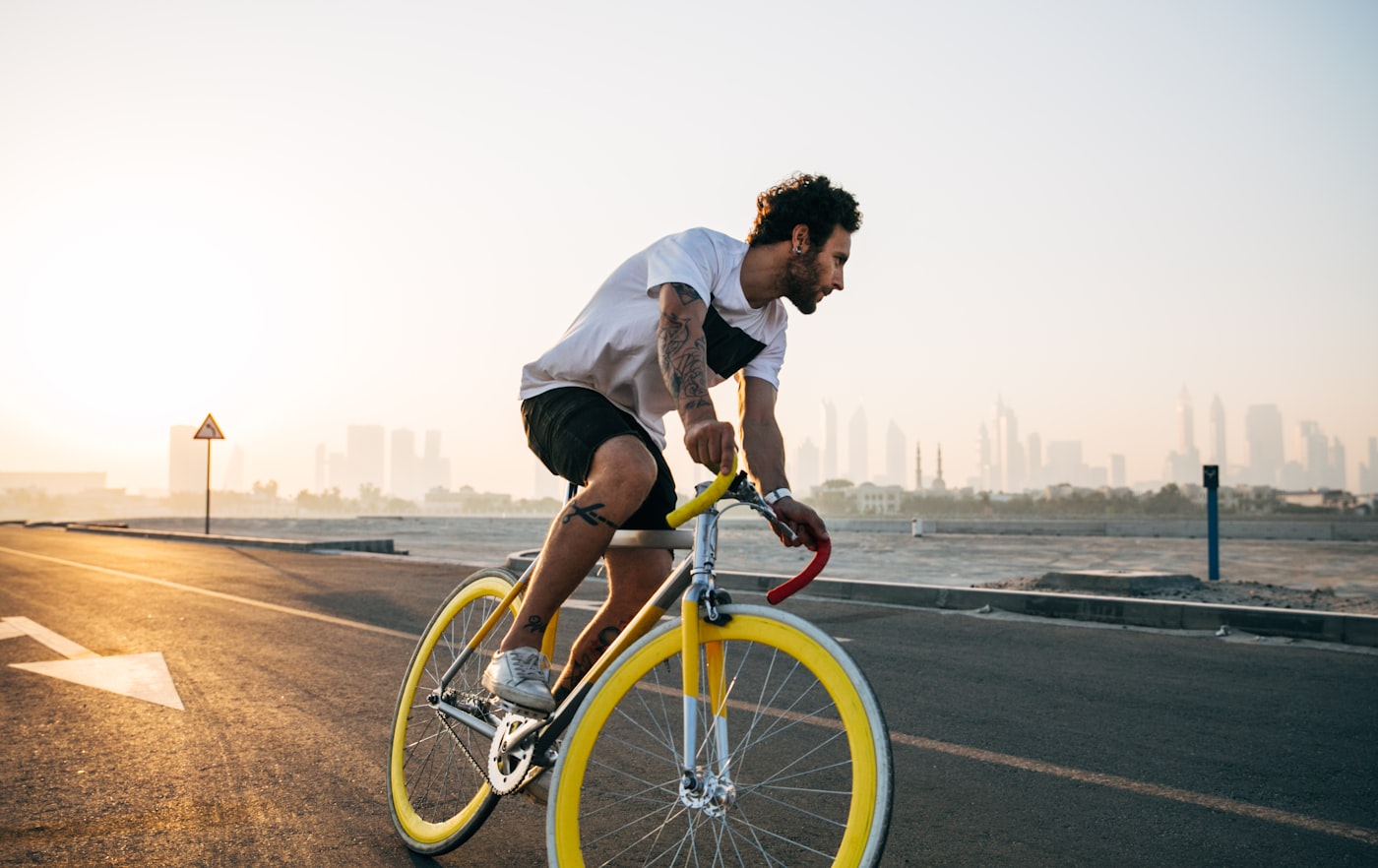
Short answer: MOQ for bicycles from China is set per model and per colour, not per shipment. Typical 2026 levels are 25-50 units for e-bikes, 25-75 for road bikes, 50-150 for city and commuter bikes, 50-100 for mountain and folding bikes, and 100-250 for kids' bikes. Factories set them because every model change costs line changeover time, component purchasing minimums and paint batch minimums — and OEM branding, a custom colour or a private frame mould pushes the number higher.
What does MOQ mean on a bicycle quotation?
MOQ is a production threshold, not a sales target, and on bicycles it is counted per SKU: one model, one colour, one frame-size group. A buyer planning 200 bikes across four models and three colours is not placing four orders above MOQ but twelve small ones. Three separate minimums sit behind the number you are quoted:
- Factory MOQ — the volume that justifies stopping and re-setting the assembly line for your model.
- Component MOQ — minimums the factory's own suppliers impose on tyres, rims, saddles, decals and cartons.
- Order MOQ — the total size, across models, that makes the transaction worth booking and documenting.
A short order MOQ is usually solved by adding a second model; a short component MOQ, by accepting a stock colour or tyre.
Why do Chinese bicycle factories set an MOQ?
The number is not arbitrary. Four concrete costs sit under it.
- Line changeover. A line runs one model at a time — wheel-build spec, jigs, torque values, cable lengths, carton size. Switching models costs half a shift to a full shift of zero output.
- Component purchasing. Tyres, rims, hubs, saddles and drivetrains are bought in batches, each with its own supplier minimum. Below a certain volume the factory carries surplus stock or pays small-batch handling.
- Paint and finishing. Coating lines run in colour batches. A colour change means purging the line, and a custom Pantone match means a dedicated batch nobody else can use.
- Tooling and certification. A private frame mould is amortised over units, and so is testing: EN ISO 4210, EN 15194 for e-bikes, EN ISO 8098 for children's bikes, CPSC 16 CFR 1512 for the United States, plus UL 2849 and UN 38.3 on the electrical side.
What are typical bicycle MOQs by bike type?
| Bike type | Typical MOQ (per model and colour) | What drives the level | Standards usually referenced |
| E-bikes | 25-50 | High unit value; motor and battery in small lots | EN 15194, UL 2849, UN 38.3 |
| Road bikes | 25-75 | High value, specialised frames, shorter runs | EN ISO 4210-2/-6 |
| Mountain bikes | 50-100 | Fork and drivetrain purchasing minimums | EN ISO 4210-2/-5 |
| Folding bikes | 50-100 | Hinge and latch tooling, dedicated carton | EN ISO 4210-2 |
| City / commuter | 50-150 | Volume category with racks, guards, lighting | EN ISO 4210-2/-9 |
| Kids' bikes | 100-250 | Low unit value; viable only in long runs | EN ISO 8098, CPSC 16 CFR 1512 |
These are the levels we work with day to day: a realistic starting point, not a fixed wall.
How do OEM branding and custom colour raise the MOQ?
| Customisation level | What it involves | Effect on MOQ | Extra lead time |
| Stock model, factory colour, your decals | Decal and carton printing only | Baseline | 3-7 days |
| Stock model, custom Pantone colour | Line purge, dedicated paint batch | Often 1.5-2x baseline | 7-15 days |
| Custom spec on an existing frame | Component swaps at supplier minimums | Baseline to 1.5x | 10-20 days |
| Private frame mould / own geometry | Tooling, prototypes, full EN ISO 4210 retest | Commonly 300-500+ | 45-90 days |
The deeper the customisation, the more resource is committed to you alone, and the more units are needed to justify it. Our OEM and ODM page sets out what each level requires.
How does MOQ interact with container loading?
MOQ is half the arithmetic; the other half is how bikes fill a container — roughly 250-300 in a 20ft, 450-520 in a 40ft and 500-600 in a 40ft HQ, fewer for e-bikes because battery weight and protective packing consume both volume and payload. Three models at an MOQ of 50 give you 150 bikes: an LCL shipment or a share of a consolidated FCL rather than a container of your own. Classification is unchanged either way — HS 8712.00 for conventional bicycles, HS 8711.60 for e-bikes — and Incoterms (EXW, FOB, CIF, DDP) change what your landed cost includes, not the factory's MOQ. Our importer guide covers loading and documentation.
Frequently asked questions
Is bicycle MOQ per order or per model?
Almost always per model and per colour, because that is the unit the production and paint lines are set up for. A total order can combine several models, but each model must reach its own minimum. Confirm in writing which basis a quoted MOQ uses.
Can I mix several models to reach the MOQ?
Mixing models fills a container and builds an attractive order size, but it rarely satisfies a per-model MOQ. The practical exception is a family of models sharing one frame, paint and carton, where changeover cost is small. Ask which models genuinely share a platform.
Why do e-bikes have a lower MOQ than kids' bikes?
MOQ tracks value per unit as much as production effort. An e-bike carries a motor, controller and battery, so 25-50 units is already a serious commitment. A kids' bicycle is low-value and high-volume, and its margin only works over a long run — hence 100-250 units.
Does putting my own brand on the bikes raise the MOQ?
Decals and printed cartons usually do not, beyond the print run minimum. A custom Pantone frame colour typically does, because it commits a dedicated paint batch. A private frame mould raises it substantially, since tooling and a fresh EN ISO 4210 test campaign must be amortised.
Is bicycle MOQ negotiable?
Often, within limits: factories have more room on order MOQ than on component or paint minimums, and repeat business, a clean specification and a firm shipping window all help. We cover the tactics that work in our guide on negotiating MOQ with a Chinese bicycle factory.
What are my options if my volume is below MOQ?
Three routes normally work: take a stock model in a factory colour, join a consolidated shipment where several buyers share the run, or place a trial order at a higher unit cost and scale on the second. Tell us your realistic first-year volume.
Where Source of Bikes fits
Finding out which factory accepts your volume, in your colour, with your spec, is normally months of enquiries and dead ends. With 15+ years of export experience and long-standing relationships across China's bicycle clusters, we already know which of our vetted factories run low minimums in which categories, and we match the factory to your project rather than the reverse. We handle 100% pre-shipment inspection, FCL or LCL consolidation and export documentation across the 50+ countries we serve.
Send us your model list, target volume per model and destination country, and we will come back with a tailored quotation and the real MOQ for your project. Message us on WhatsApp at +8617702000155 or email [email protected], and browse our bicycle range to start your specification.
